Friday, 27 February 2015

Destination: Bali, Indonesia (Part 1: Tales of the Sun, Sea and Spirit)

Location: Discovery Kartika Plaza Hotel, Kuta

Flying from Kuala Lumpur to Bali on a sunny morning could have been a good journey, but no, am I wrong! Turbulence occurred midway as our airliner was crossing the Java Sea. Previous experiences told me that turbulence normally occurs if we are trapped in a bad weather or such. But in this case I can still see the clear blue sky outside the window! I braced myself and prayed that the three-hour flight would quickly pass.

Landing at the Ngurah Rai International Airport in Bali, I was greeted by the whiff of incense and a statue of a character from Indonesia’s folklore; I guess it must have been the Garuda, based on its bird-like appearance. Though Indonesia has a large Muslim population, the majority of the people in Bali are Hindus. And, the Hindu rituals in Indonesia are unique and differred from Hindus from other parts of the world.
An acquaintance greeted me and asked if I had a good journey. I told him about the turbulence and he said, half-jokingly, maybe the Java Sea “ada banyak hantu” (has a lot of ghosts in there). Then he rushed me to a waiting car, and I didn’t get a chance to appreciate the architecture of the airport – which, on my first impression, is a mixture of modern and traditional Balinese design.
The Discovery Kartika Plaza Hotel in Kuta, a five-star hotel overlooking the sea, was where I stayed during the trip. Though my ground-floor room didn’t have a good view of the sea, but I am happy for getting a comfortable king-sized bed, stacked with lots of fluffy pillows, all to myself!


Several pictures around the hotel grounds.

I spent the afternoon exploring the hotel grounds, appraising its landscape and also its Balinese features – which were embedded in the form of Balinese gates, statues of deities and Indonesian mythical creatures, as well as a mini Hindu temple near the hotel swimming pool. 
This photo tells of pure bliss by the sea in Bali.
There is a set of rules for entering a Hindu temple in Bali which was put up in front of the small temple. I was quite astounded when I read the list, as I really didn’t expect it at all. Among the basic rules for entering a Hindu temple in Bali:
  • Menstruating ladies should not enter a temple. The same directive goes to anyone who has a bleeding cut or injury. This is to avoid any blood stains on the holy grounds.
  • Visitors must wear a specific sash around their waist or a sarong, depending on the temple rules. No worries as the sash and the sarong are usually provided by the temple (I have to wear a sash during my visit to Uluwatu temple later during this trip).
  • Visitors must wear proper clothing. No shorts or bare shoulders.

There are other rules pertaining to how a visitor should behave when there is a religious ceremony inside a temple, but I could not make out the words as it had been smudged with time and weather.
The small temple inside the compounds of Kartika Discovery Plaza Hotel

Now I realized why Bali is called the land of a thousand temples. It is said that there are more than 4,000 temples in Bali, and you can find it at places such as hotel grounds and also private home compounds.
Another attribute that interests me were small boxes of offerings to the spirits, which can also be found almost anywhere in Bali. The people would leave the offerings not only in the temples, but also at places such as the front of their shop and by the sea. The boxes are made of woven leaves (I believe it must be banana leaves) and filled with offerings such as incense sticks, flowers, as well as food items like biscuits and sweets (I saw a Kopiko coffee candy in one box).

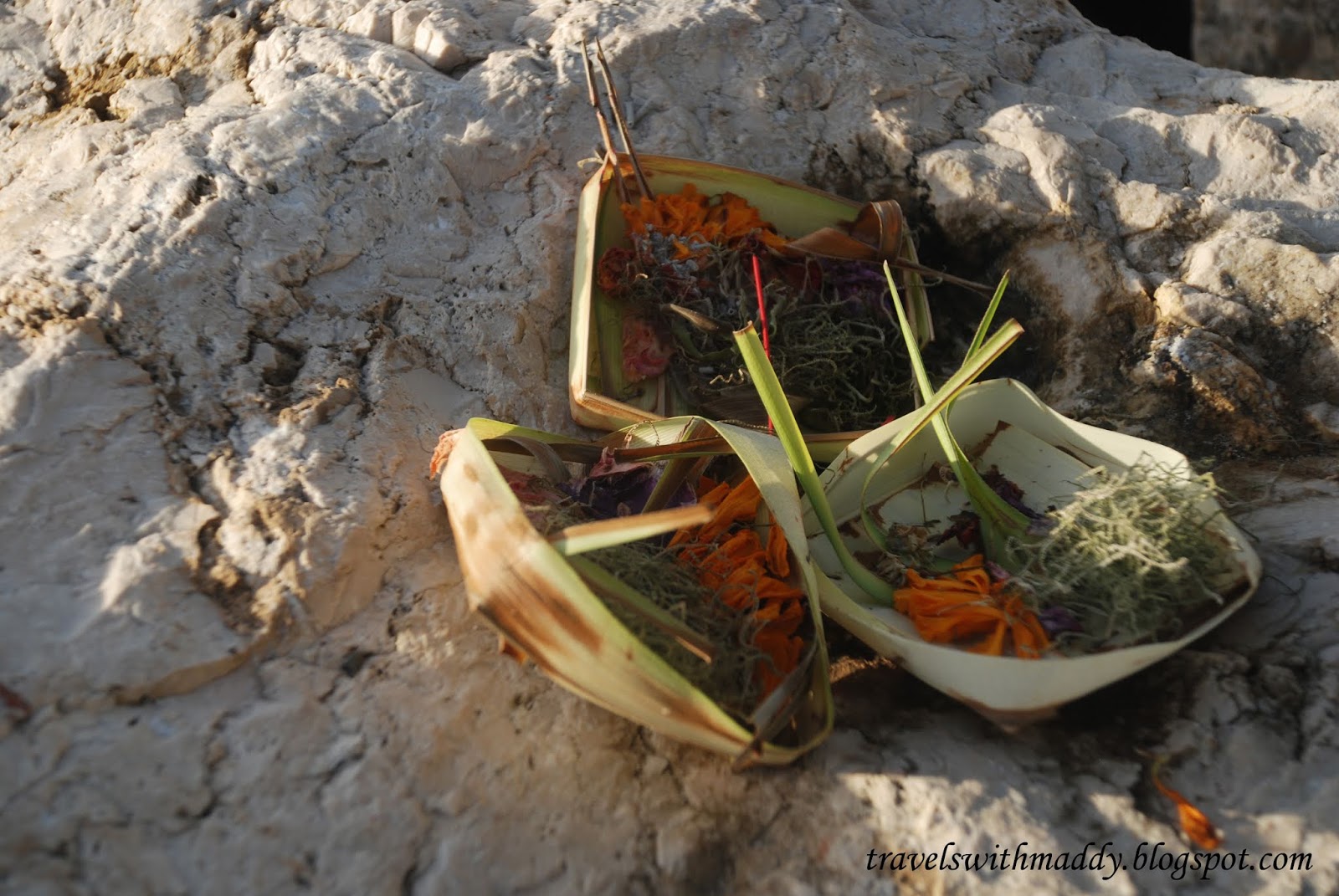
Small boxes of offerings can be found in every nook and cranny in Bali

The back of the hotel opened towards the sea – yes, the sea and without the beach. I guess the seawater is deep there, thus the no swimming sign. People only fished there, and I saw an unoccupied boat floating not far away. There is a footpath along the sea waters, so I turned right and walked along. I could see a beach in the not-so-far distance, where people were playing kites, having fun and swimming in the sea.
As I walked along, I realized that there’s a shopping complex just next door of the hotel. The Discovery Mall, though not as immense and glitzy as those malls which can be found in bigger cities, has a sort of open souvenir and craft  ‘bazaar’. It sells a wide variety of items such as woodcarvings, Indonesian batik cloths, Balinese spa products, figurines, and Balinese coffee.
The Discovery Shopping Mall is just next door to the hotel

Then I left the mall and decided to have a walk at the beach. Many people set up stalls along the beach to sell items such as t-shirts, caps, and sunglasses. There’s also the solo peddler who walked along the path carrying their goods; they either approached tourists to sell, or they just spread their goods on the ground and waited for people to buy something from them. These peddlers also trade some amazing items, such as accessories made out of seashells and also kites the shape of a large vessel.


A flying ship? This kite is sold by several peddlers by the beach.

As my first day in Bali came to an end, I am very pleased to know that Discovery Kartika Plaza Hotel doesn’t only open up to the sea, but also to a wonderful sunset view. I spent quite some time photographing the setting sun, and the result was marvellous!


Sunday, 26 January 2014

Destination: Perlis, Malaysia (Part 3: Exploring the Caves... and a Secret Garden)

Location: Gua Kelam

Gua Kelam literally means The Dark Caves (or The Cave of Darkness, as written on one signboard in the area). Gua Kelam is further north, and you will be driving through remote territories. I didn’t encounter many cars on the way there. With no help from the GPS, I just followed the signboard that says Kaki Bukit, the town where Gua Kelam is situated. As long as I can still see the signboard or the mile stones that stated “Gua Kelam”, I know I’m on the right track.
Historically, the area used to have tin mines, and there were remote villages separated from each other by limestone hills. Gua Kelam, which is a natural cave believed to be formed by the stream underneath, were discovered connecting the separated towns. Boardwalks were then build inside the caves, and Gua Kelam functioned as the main route for villagers, apart from being used to transport tin ores.
Entrance fee is just RM 1, and you can enjoy all the fascinating geological formations inside the million-years old cave. Coloured lights added more dramatic effects on the formations. Here are oh-so-many pictures I took inside the cave (I particularly enjoy appreciating the beauty of cave interiors, FYI). Sorry some pictures are a bit shaky!


This one: do you see a hawk or a tortoise head with its mouth wide open?

And this one - what do you see?
Halfway through the cave, I came across a group of local men holding plastic buckets underneath a few stalactites. Obviously, they were collecting the water dripping from the stalactites. Curious, I asked them what they were up to. According to the men, it is believed that the water can heal victims of black magic. Intriguing, huh?
These two men are collecting cave waters to sell to traditional healers.

FOOT NOTE: Traditionally, the Malays believed that some people use black magic to cause devastation to the lives of others, typically their rivals or enemies. If they succeeded, the victim usually succumbed to a mysterious illness in which the conventional doctor will never be able to diagnose. For example, the victim might claim that they got the fever because they felt so cold, but when checked by a doctor, the victim’s body temperature is actually normal. Other ‘symptoms’ usually mentioned when somebody is hit by black magic is that they will start to cough and vomit blood (which can sometimes contain sharp items like small knives or daggers too). Back to the men in the caves, they were claiming that water sourced from a cave can heal victims of black magic.
I then left the men and continued my walk. I found many more interesting formations, one of it shaped like a traditional Malay drum called gendang (according to my eyes). Another formation resembled the Pamukkale hot water pools in Turkey, but of a smaller scale. Interestingly, when I look close enough at the surface of the structure, I realized that it actually glitters.
This formation looks like the Malaysian 'gendang'.

I think this one has a resemblance to the Pamukkale hot springs.

This formation seems to sparkle and glitter in the dark.

A close-up of the glittering and sparkling surface.. I tried my best to capture it!

Finally I arrived at an opening, which meant that I have arrived at the other side of Gua Kelam. I saw the signboard stating “Secret Garden, Gua Kelam”. Lush greenery met my eyes. Rolling limestone hills. And crystal clear waters. Everything is unpolluted, though the gardens are not 100% natural. No need to say more, just look at these pictures and it will tell you how beautiful the place is:


This staircase (pictured on right) leads to another cave which must be explored with a guide.


Failing to resist the clear waters, I carefully tiptoed to the edge of the pool to dip my feet. Unfortunately, the rocks by the banks were very slippery that I fell down into the (luckily) shallow water. I got my underside thumped on the slippery rocks first, and my right ankle hit the hard pebbles underwater. Ouch!
I strolled around the area for quite a distance and realized that in order to get back to my car, I have to cross through the cave once again because the two sides of the caves are separated after all. And so my Gua Kelam exploration ended with a bruised ankle and a soiled t-shirt.

Saturday, 25 January 2014

Destination: Perlis, Malaysia (Part 2: The Story of an 'Unfruitful' Trip)

Location: Taman Anggur Perlis & Harumanis Mango Plantation

As soon as I arrived at Perlis' capital city Arau, I quickly rent a car to drive through the northern state. For me, driving through Perlis is easy! Apart from the signboards, the state is also small enough that you WILL find your way somehow.
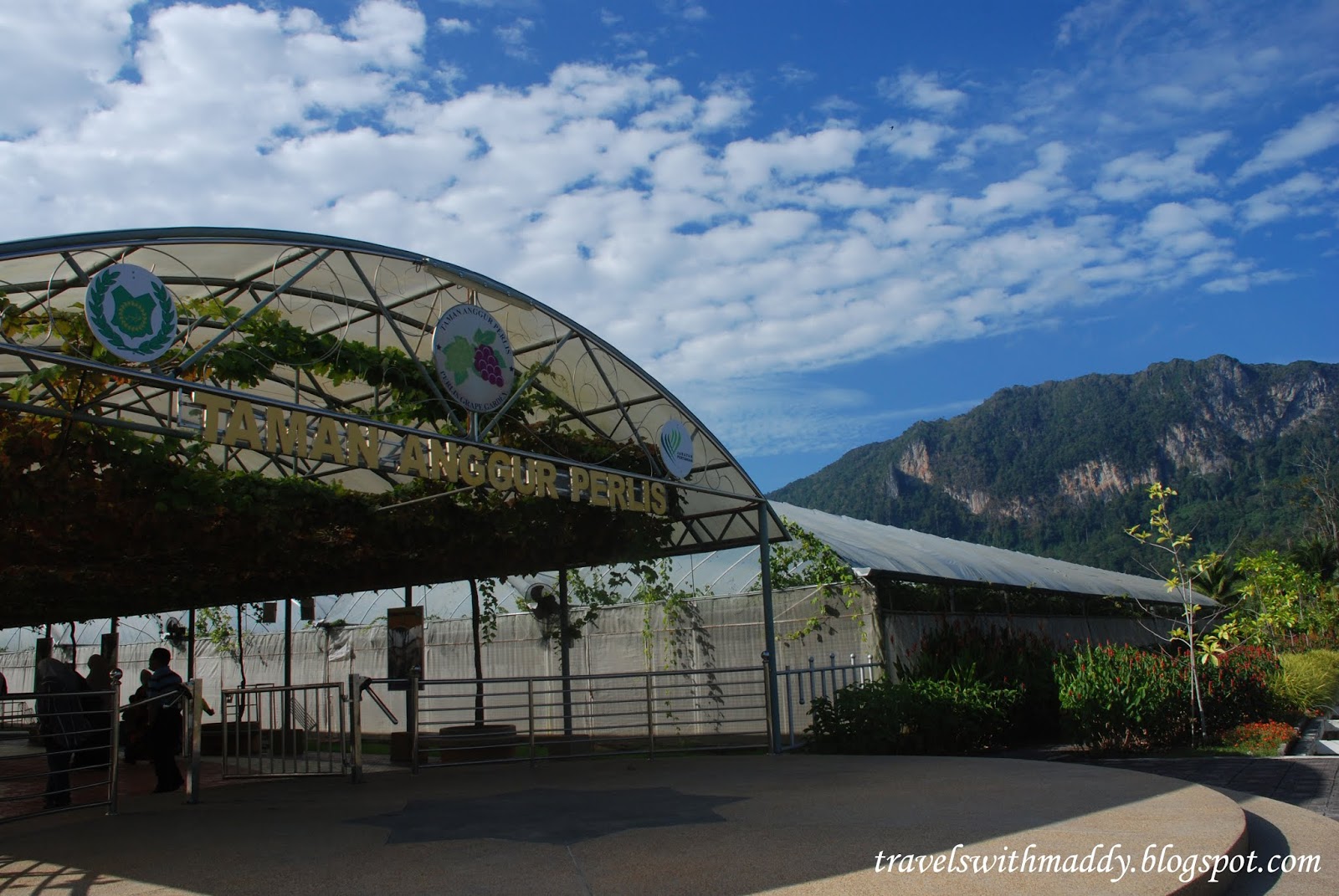
My first destination was the grape plantations (Taman Anggur Perlis) which I visited just a month ago. Now that I’m driving myself, I got the opportunity to test my memory in recalling the road to that place. So how to reach Taman Anggur Perlis? It’s easy: just follow the signboard to the Snake and Reptile Farm (Taman Ular), or any signboard leading to Batu Pahat. When the Harumanis Mango Plantation is in sight (at your right), stop following the Snake Farm signboard. Just go straight on; the grape plantation is just ahead, on your left.


The panorama around the grape plantation is absolutely gorgeous, with rolling hills and lush greeneries.
Unfortunately, I was not in luck because the grapes on the trees are not yet available for picking. If you are lucky you can experience harvesting some grapes here, at a certain price.

Oh, look at those beautiful grapes! And why, oh why, are you not available for harvest when I came? Sigh..
So I took to the wheel again and stopped at the Harumanis Mango Plantation, only to discover that the Harumanis mango was not in season! There were no fruits on the trees at all...according to one of the men at the plantation office, the Harumanis mango is available in May every year. Okay, so here I am, at the mango plantation, and it’s January. Double unlucky!
Frustrated, I drove further north to my next planned destination, Gua Kelam.